Introduction
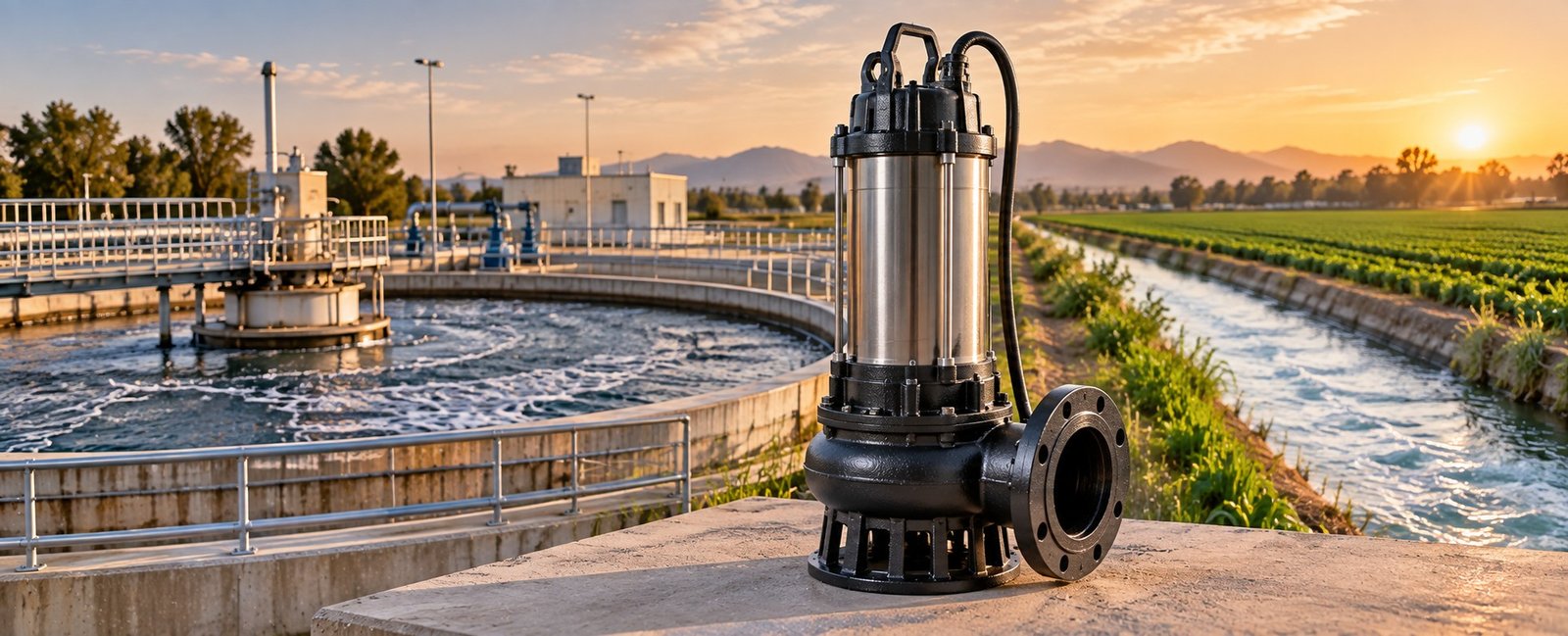
Search for “dewatering pump” and search for “treated wastewater reuse” in Saudi Arabia, and you’ll eventually land on the same equipment. Moving wastewater out of a collection point, through treatment, and into a reuse distribution network relies on the same core pump technology, submersible units built to handle solids-laden effluent reliably, at scale, under continuous duty. This piece looks at why treated wastewater reuse has become one of the more concrete, fast-growing areas of Saudi Arabia’s water sector, and what it actually means for suppliers of dewatering and submersible sewage pumps specifically.
Why Treated Wastewater Reuse Is a Genuine Saudi Priority, Not a Niche Topic
Why it matters: Saudi Arabia’s treated wastewater reuse targets have been revised upward significantly over the past several years, reflecting how central this has become to national water strategy. Earlier Vision 2030 planning targeted raising reuse from roughly 17.3 percent in 2019 to 25 percent by 2025. That target has since been superseded by considerably more ambitious goals: the National Water Strategy has set a target of increasing treated sewage effluent (TSE) reuse to 70 percent, close to 4 million cubic metres per day, by 2030, while more recent reporting describes a government target of achieving 100 percent reuse of treated urban wastewater. Given the evolution of these figures across different planning documents and reporting periods, the consistent underlying signal matters more than any single number: reuse targets have moved sharply upward, not incrementally, and the infrastructure investment behind them has followed.
This connects directly to the broader strategic shift covered in our piece on Saudi Arabia’s move from building plants to optimizing networks, where treated wastewater reuse sits alongside network efficiency and groundwater protection as one of the three pillars of the Kingdom’s current water policy direction, explicitly named alongside desalination rather than treated as a secondary concern.
Where Treated Wastewater Actually Gets Reused
Why it matters: Understanding where reused water actually goes clarifies the range of infrastructure, and pumping applications, this sector actually requires.
Agricultural and landscape irrigation together represent roughly two-thirds of Saudi Arabia’s current treated wastewater reuse, the largest single application by volume. Industrial reuse represents a second major category, illustrated concretely by a $33.5 million contract secured in early 2024 for a 20 million litre per day industrial wastewater treatment facility at Saudi Aramco’s Ras Tanura refinery, using biological treatment, filtration, and reverse osmosis to enable partial water reuse directly within refinery operations. Beyond irrigation and industrial use, treated wastewater is also applied to aquifer recharge, helping replenish groundwater reserves, and district cooling systems, an application with its own significant water demand in the Kingdom’s hot climate.
The Real Numbers: A Multi-Billion Dollar, Growing Market
Why it matters: This isn’t a marginal segment of Saudi Arabia’s water sector, it’s one of its largest and fastest-growing components.
Saudi Arabia’s water reuse market has been estimated as the third largest in the world, behind only China and the United States, valued at approximately $4.69 billion. The broader Saudi water and wastewater treatment market is projected to grow from roughly $4.03 billion in 2024 to $7.43 billion by 2033, a compound annual growth rate of approximately 7.05 percent. At the same time, Saudi Arabia currently operates roughly 70 sewage treatment plants nationwide, treating only around half of total wastewater generated, meaning substantial expansion in both treatment capacity and downstream reuse infrastructure is still required to meet the Kingdom’s stated targets.
The Energy Case for Reuse
Why it matters: As covered in our piece on the Kingdom’s shift toward network optimization, Saudi Arabia’s desalination-heavy water supply carries a direct, significant energy cost, and wastewater reuse offers a way to reduce dependence on that energy-intensive production pathway specifically.
Research modeling water conservation opportunities in Saudi Arabia’s oil and gas sector found that increased water reuse could conserve up to 29 percent of total industrial water withdrawals in that sector alone. Separate analysis found that increasing wastewater treatment and reuse specifically across six high-altitude inland cities could save an estimated $225 million and conserve roughly 2 percent of Saudi Arabia’s total annual electricity consumption. These figures reinforce why reuse investment continues accelerating: every cubic metre of treated wastewater reused is a cubic metre that doesn’t need to be produced through energy-intensive desalination and transported inland, sometimes hundreds of kilometres and hundreds of metres in elevation, to reach the same end user.
What Reuse Infrastructure Actually Needs From Pump Suppliers
Why it matters: This is where the “dewatering pump” and “treated wastewater reuse” search terms genuinely converge on the same underlying equipment need.
- Lifting and collection pumps move raw wastewater from collection points into the treatment process, a continuous-duty application requiring reliable submersible sewage pumps built specifically to handle solids-laden effluent without clogging or premature wear.
- Sludge dewatering pumps manage the concentrated solids separated during treatment, a distinct, demanding application requiring equipment engineered for high-solids-content handling rather than clean water service, covered in more depth in our guide on industrial water pump solutions.
- Effluent transfer and distribution pumps move treated water from treatment facilities into irrigation networks, industrial reuse systems, or aquifer recharge points, applications requiring sustained, continuous-duty operation similar to any large-scale water transmission system.
- Industrial-grade dewatering pumps support facility-level reuse projects specifically, like the Aramco Ras Tanura example, where treated effluent needs to be moved through on-site filtration and reverse osmosis systems as part of a closed-loop industrial reuse process.
Practical Takeaways for Pump Suppliers
- Position dewatering and submersible sewage pump lines specifically for reuse infrastructure, not only conventional sewage collection, given how directly national reuse targets are driving demand for this exact equipment category.
- Track SWPC-linked private sector wastewater and reuse project tenders, since the Saudi Water Partnership Company’s continued push to increase private sector participation is likely to generate an ongoing pipeline of infrastructure procurement beyond NWC’s own direct programmes.
- Recognize industrial reuse as a distinct, higher-value niche. Facility-level reuse projects like the Ras Tanura example represent a genuinely different application and specification standard than municipal irrigation reuse, worth targeting separately.
- Connect reuse infrastructure positioning to the broader NWC sewage treatment pipeline, covered in our piece on NWC’s tender for 10 new sewage treatment plants, since treatment capacity expansion and reuse infrastructure growth are directly linked, more treated wastewater available for reuse depends on more treatment capacity coming online first.
Conclusion
Treated wastewater reuse has moved from a secondary sustainability initiative to one of the central pillars of Saudi Arabia’s water strategy, backed by a multi-billion dollar market, aggressive national targets, and a clear energy-cost rationale tied directly to the Kingdom’s reliance on desalination. For pump suppliers, the equipment underpinning this entire sector, submersible sewage pumps, dewatering pumps, and continuous-duty transfer systems, is the same core product category already covered throughout this site’s industrial and construction-focused content, meaning suppliers already positioned in dewatering and sewage handling equipment have a direct, natural path into one of the Kingdom’s fastest-growing water infrastructure segments.
Your next steps:
- Evaluate your dewatering and submersible sewage pump range against the specific demands of collection, treatment, and reuse distribution applications.
- Track SWPC and NWC reuse-linked project announcements for near-term procurement opportunities.
- Explore Kanzotech’s submersible sewage pump range and industrial pump range for equipment built to continuous-duty wastewater handling standards.
Positioning for pump supply in Saudi Arabia’s treated wastewater reuse sector? Contact Kanzotech Pumps to discuss your technical requirements.



 September 11, 2026
 HYZAM KENZ





Comments
No comments yet. Be the first to comment!