Industrial Pump Selection What Process Engineers Need to Get Right
Water moves through every industrial facility in Saudi Arabia, cooling towers, fire systems, process washdown, boiler feed, HVAC circuits. The pumps that move it are often treated as an afterthought. They shouldn’t be.
“A food processing plant in Jeddah had four cooling tower pumps installed and all correctly sized on paper. Within eight months, two were replaced. The problem wasn’t the flow rate or the heead calculation. It was that nobody accounted for the 47°C summer ambient temperature on the motor rating, and the motors were running at 112% of their thermal design limit every afternoon from June to September.”
— Kanzotech Pumps
Water is the most underappreciated utility in any industrial facility. It cools equipment, feeds boilers, flows through HVAC systems, supplies fire protection networks, and handles washdown across production areas. When water supply is reliable and pressure is consistent, nobody notices the pumps. When it isn’t, everything stops.
The challenge in Saudi industrial facilities specifically is that standard water pump selection practices developed largely for European or North American conditions don’t fully account for what happens to pump performance when ambient temperatures exceed 45°C for five months of the year, when process water contains dissolved minerals from desalinated or treated sources, and when energy costs must comply with Saudi Energy Efficiency Center standards.
At Kanzotech Pumps, we supply water pump systems to manufacturing plants, food processing facilities, water treatment operations, and industrial complexes across the Kingdom based on your requirment. This guide covers what actually drives correct water pump selection in Saudi industrial settings , not the generic theory, but the decisions that determine whether a system runs reliably through peak summer or starts causing problems in July.
How Industrial Water Pump Duty Differs from Other Applications
Water pump selection for a residential building or a construction site is relatively straightforward , the system runs intermittently, the flow demand is predictable, and failure is inconvenient rather than catastrophic. Industrial water systems operate under fundamentally different conditions.
Continuous Operation Changes the Equation
Most industrial water pumps in manufacturing facilities run 6,000–8,760 hours per year. A cooling tower pump on a continuous production line never stops when the plant is running. A boiler feed pump cycles constantly to maintain steam pressure. A fire jockey pump maintains system pressure 24 hours a day.
At this operating intensity, the selection criteria shift. Efficiency at the actual operating point matters more than peak efficiency. A pump running 8,000 hours/year at 78% efficiency versus 82% efficiency is consuming an additional 4% of its rated power continuously , for a 22 kW pump, that’s approximately SAR 8,000–12,000 in additional annual electricity cost at Saudi industrial tariff rates. Over a 10-year pump life, the energy cost difference between a well-selected and a poorly-selected pump often exceeds the pump’s original purchase price several times over.
System Demand Varies and the Pump Must Handle All of It
Industrial water systems rarely run at a single fixed operating point. A cooling water circuit serving multiple production lines sees demand rise and fall as lines start up and shut down. An HVAC chilled water system changes flow as zones open and close throughout the day. A fire protection system that normally runs at low jockey pump flow suddenly demands full main pump output when a sprinkler activates.
A pump selected only for the design operating point , the peak or average flow at target head , will run outside its best efficiency range whenever the system demand shifts. In industrial water systems, it’s normal for actual operating conditions to vary 30–50% from design. The pump must perform efficiently and without cavitation or surge across that entire range, not just at the single design point that was optimized during selection.
Most Common Selection Error in Saudi Industrial Plants
Selecting a water pump based on design flow and head without mapping the full system demand range , from minimum turndown to peak demand. A pump that hits its design point perfectly may still be running in surge territory at minimum flow, or cavitating when the system resistance is lower than anticipated. Map your system curve across all operating modes before opening a pump catalog.
The Four Water Pump Types Used in Industrial Facilities
Industrial water systems use a narrower range of pump types than industrial process systems in general because water’s consistent properties (low viscosity, known temperature range, predictable density) make centrifugal pump designs the dominant and almost universal choice. What changes between applications is the specific centrifugal pump configuration.
End-Suction Centrifugal Pumps
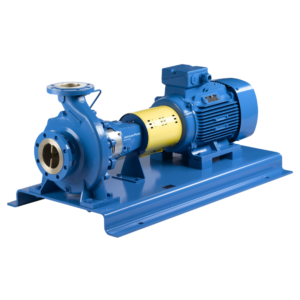
The workhorse of industrial water systems. Single-stage, horizontal, close-coupled or frame-mounted. Covers the majority of water transfer, cooling, and circulation duties in manufacturing facilities. Simple to maintain, widely available, and well-understood by plant maintenance teams across Saudi Arabia.
Primary Industrial Applications :
Cooling tower supply and return, process washdown, general water transfer, plant utility water
Multistage Centrifugal Pumps
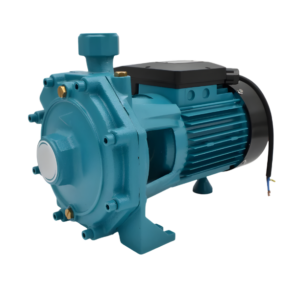
Multiple impeller stages in series generate higher pressure than a single stage allows. Used where the system requires above 80–100m head , high-rise building water supply, boiler feed systems, high-pressure washdown, and reverse osmosis feed in water treatment plants within industrial facilities.
Primary Industrial Applications :
Boiler feed, high-pressure washdown, RO feed water, high-rise facility water supply
Split-Case (Double-Suction) Pumps
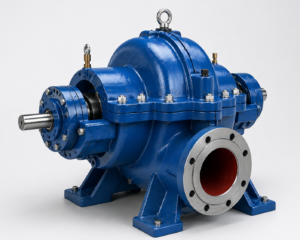
Horizontally split casing allows access to internals without disconnecting the pump from the piping. Double-suction impeller design provides inherently balanced axial thrust and significantly lower NPSH requirements than equivalent single-suction pumps. Used for high-flow, high-reliability applications where maintenance access and NPSH margin are critical.
Primary Industrial Applications :
Fire protection main pumps, large cooling water circuits, municipal-scale water supply within industrial campuses
Vertical Turbine Pumps
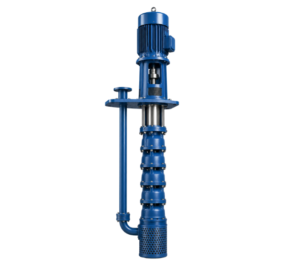
Column-mounted pump with the motor at surface and impeller stages submerged in the water source. Used for pumping from sumps, underground tanks, wet wells, and deep water sources within industrial facilities. The vertical configuration eliminates priming requirements and allows operation at low NPSH conditions that would cavitate horizontal pumps.
Primary Industrial Applications :
Sump pumping, underground storage tanks, industrial fire water tanks, stormwater management
Good to Know
Beyond Water — Pumps That Handle Oil and Viscous Fluids
Everything covered in this guide focuses on water transfer which is what Kanzotech Pumps specialises in. But industrial facilities also contain systems that move fluids very different from water, and it’s worth understanding what handles those so you can direct the right specification to the right supplier.
Gear pumps are the standard choice for lubricating oil circuits, fuel oil transfer, and hydraulic systems. They work as positive displacement devices , a pair of meshing gears trap a fixed volume of fluid per rotation and push it through the outlet regardless of pressure. This gives them consistent, pulse-free flow even at high viscosities where centrifugal pumps lose efficiency rapidly. A centrifugal pump’s performance degrades quickly above 50–100 cP viscosity; a gear pump handles 1,000–50,000 cP routinely. In manufacturing plants, you’ll find gear pumps in gearbox lubrication skids, fuel day tanks, hydraulic power units, and heavy oil transfer systems.
Screw pumps handle a similar viscosity range to gear pumps but with lower pulsation and better handling of entrained gases making them common in crude oil loading, lube oil systems, and marine fuel transfer. Progressive cavity pumps extend this further into sludge, slurry, and highly viscous or abrasive fluid transfer that neither centrifugal nor gear pumps can manage cleanly.
The key distinction: If your fluid is water clean, hot, mineral-laden, treated, or pressurised, a centrifugal pump in one of its four configurations (end-suction, multistage, split-case, or vertical turbine) is almost certainly the right answer. If your fluid is oil, fuel, heavy chemical, or anything with viscosity above 50 cP, you’re in positive displacement territory and need a specialist supplier for that product category. Kanzotech focuses on water for everything else, specify accordingly and source from the appropriate vendor.
The Six Factors That Determine Correct Water Pump Selection
For water specifically as opposed to viscous or chemically aggressive fluids , the selection factors are fewer but still require careful analysis. Skipping any of these is where industrial water pump selections go wrong in Saudi facilities.
Flow Rate — At All Operating Modes
Define minimum, normal, and maximum flow for every operating mode the system will experience. A cooling water pump serving four production lines must handle everything from one line running (minimum flow) to all four plus startup surge (peak flow). Map all modes before sizing.
Total Dynamic Head
Static head plus friction losses in pipe network plus minor losses at valves, fittings, and equipment. For industrial systems with long pipe runs and multiple control valves, friction head often exceeds static head. Always calculate at maximum flow — this is where friction losses peak and determine the worst-case duty point.
Water Temperature and NPSH
Hot water in boiler feed or high-temperature process cooling circuits has higher vapor pressure, reducing available NPSH significantly. A pump with adequate NPSH margin for cold water may cavitate when system temperature rises to 60°C or above. Always verify NPSH at maximum operating temperature.
Water Quality and Suspended Solids
Industrial process water, cooling tower water, and facility washdown water all vary in quality. Cooling tower water with biocide treatment, scale inhibitors, and 3–5 cycles of concentration has different requirements than clean utility water. Suspended solids in washdown water require open impeller designs or larger clearances.
Operating Hours and Efficiency
For pumps running more than 4,000 hours annually, energy cost over the pump’s life dwarfs its purchase price. A 5-percentage-point difference in pump efficiency on a 30 kW motor running 8,000 hours/year costs approximately SAR 18,000 more per year in electricity at current Saudi industrial tariffs. Specify minimum pump efficiency at the design operating point.
Redundancy and Uptime Requirements
Critical cooling water, fire protection, and boiler feed systems require N+1 redundancy one standby pump ready to start automatically if the duty pump fails. The standby pump must be the same model and specification as the duty pump. Different models create maintenance complexity and spare parts duplication that undermines the redundancy benefit.
The Factor Most Industrial Teams Underestimate: System Interaction
A water pump operates within a piping system whose resistance changes continuously as control valves open and close, as filters load with debris, as multiple pumps run in parallel, and as system pressure requirements vary with production demand. The pump performance curve must be matched to the system resistance curve across the full operating range, not just at the design flow point.
This becomes especially important in Saudi industrial facilities where variable frequency drives (VFDs) are increasingly mandated by SEEC energy efficiency requirements. A VFD-controlled pump changes both flow and head as speed varies, and the interaction between the variable pump curve and the fixed system curve must be analyzed to confirm the pump stays in a stable operating zone across its full speed range.
operation, that 15% mismatch in efficiency costs more than the pump itself.
Kanzotech Engineering Recommendation
For industrial water systems with VFD control, always verify that the pump remains above its minimum stable flow (typically 50–60% of BEP flow) at minimum speed. Running a VFD-controlled pump at very low speed in a high-static-head system can push the operating point into recirculation causing noise, vibration, and accelerated wear that VFD energy savings don’t compensate for. Our team models this interaction as part of every industrial pump consultation.
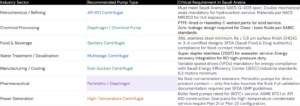
Industry-by-Industry Selection Reference
Saudi Arabia’s industrial base spans petrochemicals, food processing, water treatment, pharmaceuticals, and general manufacturing. Each sector carries specific fluid conditions and regulatory requirements that drive pump selection beyond generic guidelines.
Saudi-Specific Considerations for Industrial Water Pumps
International pump selection standards cover the engineering fundamentals. What they don’t address is the additional layer of conditions and regulations that apply specifically to industrial water systems operating in Saudi Arabia.
Ambient Temperature Impact — More Significant Than Most Realize
Standard electric motors are rated for 40°C ambient. Saudi industrial facilities regularly see 45–50°C in summer, and outdoor pump installations in direct sun can experience even higher surface temperatures. A motor that is correctly sized for 40°C ambient will run at 108–115% of its thermal design limit during Saudi summer afternoons not enough to trip the overload immediately, but enough to accelerate insulation degradation and reduce motor life from a design expectancy of 15+ years to 4–6 years.
The fix is straightforward but must be specified explicitly: derate the motor by 10–15% for outdoor Saudi summer conditions, or specify a motor with Class F insulation (155°C thermal limit) instead of the standard Class B (130°C). For motors above 37 kW in outdoor locations, a forced ventilation or water-cooled motor enclosure adds meaningful additional margin.
Water Source Quality — Desalinated vs. Well Water
Saudi industrial facilities draw utility water from three main sources: municipal treated water (increasingly desalinated), on-site reverse osmosis systems, or local groundwater. Each has different implications for pump material selection and maintenance intervals.
Desalinated water supplied by municipal networks is low in dissolved minerals but can be mildly corrosive to unprotected ferrous metals due to low buffering capacity. Standard cast iron pump casings are generally acceptable with appropriate internal coating, but impellers and shaft sleeves in stainless steel 304 minimum provide significantly better long-term durability. For on-site RO systems, the high-pressure feed side requires stainless or duplex construction throughout.
Groundwater used in Saudi industrial utilities often carries dissolved calcium, magnesium, and sometimes sulfate at levels that cause scaling in pump passageways and heat exchangers within 12–18 months. A water treatment program (scale inhibitor dosing) protects the broader system, but pump selection should account for the possibility of partial scale buildup — favoring designs with larger internal clearances and accessible impellers for periodic cleaning.
SEEC Energy Efficiency Requirements
Saudi Arabia’s Energy Efficiency Center applies specific standards to industrial pump and motor systems. For new industrial facilities and major refurbishments, IE3 motor efficiency class is the minimum requirement. For motors above 75 kW driving variable-load pumps, IE4 is recommended and increasingly expected in project specifications under Vision 2030 industrial programs.
VFD control is required for pumps serving systems where flow demand varies more than 20% — which covers virtually all cooling, HVAC, and water distribution systems in manufacturing facilities. The energy savings are real: a pump running at 80% of design speed consumes only 51% of the power it would use at full speed (due to the cube law relationship between speed and power). Kanzotech supplies VFD-integrated pump systems with SEEC documentation for new facility permit applications.
Saudi Civil Defense — Fire Pump Requirements
All industrial fire protection pump installations in Saudi Arabia require Saudi Civil Defense approval. This means the pump set must be listed to NFPA 20 (Standard for the Installation of Stationary Pumps for Fire Protection) and the installation design must be submitted to and approved by the regional Civil Defense directorate before commissioning. Diesel backup is mandatory — electric-only fire pump sets are not approved for industrial sites. Kanzotech handles Civil Defense documentation as part of fire pump supply packages.
Vision 2030 Industrial Context
“Saudi Arabia’s industrial diversification under Vision 2030 means new manufacturing facilities are being commissioned at a pace the Kingdom hasn’t seen before across food processing, pharmaceutical, advanced materials, and logistics. Many project teams are specifying pumps for applications and fluid types they haven’t worked with before in Saudi conditions. Kanzotech’s industrial team provides specification review for new facilities before procurement to catch selection errors before they become site problems.”
Sizing Industrial Water Pumps, The Calculation That Matters
For water pump selection, the two numbers that define the requirement are flow rate and total dynamic head. Getting both right across all operating conditions, not just the design point ,this is what separates correct industrial pump selection from an educated guess.
Example Calculation
Cooling Water System — Jeddah Food Processing Plant, 4 Production Lines
Peak cooling demand
240 m³/h at full production (all 4 lines running)
Minimum demand with 1 line : 80 m³/h — pump must handle full range
Static head 8m
Cooling tower basin to highest equipment connection
Friction head at peak flow : 18m
300m pipe network at 240 m³/h — Darcy-Weisbach including heat exchangers
Control valve allowance : 5m
Pressure drop across modulating control valves at design flow
Safety margin : +15% = 5m
Scale buildup in pipes over time, future capacity additions
Total Dynamic Head : 8 + 18 + 5 + 5 = 36m TDH
Selected pump spec
Two duty pumps: 140 m³/h @ 36m head each (running in parallel at peak)
Plus one standby identical unit. VFD-controlled. 18.5 kW motors derated for 48°C ambient.
Note the parallel pump configuration two smaller duty pumps instead of one large one. This approach provides inherent redundancy (one pump can run at reduced capacity if the other fails), allows efficient part-load operation (run only one pump when two production lines are operating), and makes maintenance easier since each pump can be serviced while the other covers minimum cooling demand.
For the full methodology on head and flow calculations including pipe friction tables and system curve construction, refer to our complete pump selection guide
“The pump catalogue doesn’t know it’s going to be installed outdoors in Riyadh. That’s your job to tell it — through the specification.”
— Kanzotech Pumps
Step-by-Step Industrial Water Pump Selection
Define the Water Circuit Role
Cooling supply? Boiler feed? Fire protection? HVAC chilled water? Each role has different pressure, flow consistency, and uptime requirements. The role determines whether you need variable speed control, N+1 redundancy, or specialized standards compliance (NFPA 20 for fire, SFDA for food-grade washdown).
Map All Operating Modes
Minimum flow (partial production or standby), normal operating flow, and peak demand. For cooling systems, include startup surge when cold equipment first receives cooling water. For HVAC, map flow from single-zone operation through full building peak. The pump must operate within acceptable efficiency and stability limits across all modes.
Calculate Total Dynamic Head at Peak Flow
Static head plus pipe friction losses (Darcy-Weisbach at maximum flow) plus minor losses at all valves, fittings, and equipment. Add a 15% safety margin for Saudi conditions , scale buildup over time, future additions, and pipe roughness increase as the system ages. For detailed calculation methodology see our pump selection guide
Verify NPSH at Maximum Water Temperature
Calculate available NPSHa from suction conditions at the highest system operating temperature. For cooling systems using warm return water, for boiler feed, or any elevated-temperature application, available NPSH can be significantly lower than at ambient temperature. Confirm NPSHa exceeds pump NPSHr by a minimum 0.5–1.0m margin at the worst temperature condition.
Select Pump Type and Size for BEP Operation
Choose a pump whose design point falls within 80–110% of its Best Efficiency Point at the main operating condition. Avoid pumps where the system will spend significant operating hours more than 20% from BEP this creates vibration, accelerated wear, and in some cases recirculation noise that indicates impending failure.
Specify Motor for Saudi Ambient Conditions
Apply 10–15% derating for outdoor installations or indoor locations without air conditioning. Specify Class F insulation minimum for any pump motor in Saudi outdoor service. Confirm IE3 efficiency class for SEEC compliance. Specify TEFC (Totally Enclosed Fan Cooled) with IP55 protection minimum for dust and sand exposure.
Confirm Redundancy, Controls, and Standards
Specify standby pump arrangement for critical services. Confirm VFD requirement per SEEC for variable-demand systems. Verify applicable standards: NFPA 20 for fire pumps (mandatory Saudi Civil Defense approval), ISO 9906 for performance testing, and SAES-G-005 if the facility is an Aramco contractor project. Kanzotech can confirm standards compliance for your specific project
Pre-Procurement Checklist – Industrial Water Pumps
Verification Checklist Before Equipment Order
All operating modes mapped – minimum, normal, and peak flow with corresponding head
Not just design flow. All production states and seasonal demand variation.
System resistance curve built across full flow range
Pump BEP confirmed within operating window , not just at design point
NPSH verified at maximum system water temperature
NPSHa must exceed NPSHr by minimum 0.5–1.0m at hottest operating condition
Motor derated for Saudi summer ambient – 10–15% reduction applied
Class F insulation specified for outdoor or non-air-conditioned locations
Motor efficiency confirmed – IE3 minimum, IE4 for motors above 75 kW
Per Saudi Energy Efficiency Center (SEEC) industrial requirements
VFD specified for variable-demand systems – pressure differential control configured
Minimum stable flow at lowest VFD speed confirmed above pump’s recirculation threshold
Motor enclosure rated IP55 minimum for outdoor or dusty indoor locations
Standby pump specified for critical services – same model as duty pump
Auto-start on duty pump failure. Manual changeover tested quarterly.
Fire pump set: NFPA 20 listed, diesel backup included, Civil Defense approval obtained
Approval documentation submitted before installation commences
Local spare parts availability confirmed – seals, bearings, impellers in Saudi Arabia
Lead time for emergency replacement parts from supplier’s local stock
Water Moves Through Every Industrial Facility , Make Sure It Keeps Moving
Water pump failures in industrial facilities have a way of cascading. A cooling water pump that trips brings down the equipment it cools. A boiler feed pump that underperforms affects steam pressure across the plant. A fire jockey pump that fails to maintain system pressure triggers false alarms and if not caught leaves the fire protection network exposed.
None of these outcomes are caused by bad pumps. They’re caused by pumps that were correctly functional in isolation but weren’t selected with a full understanding of what the Saudi operating environment demands of them the ambient temperature, the water quality, the variable demand, and the energy efficiency standards that now apply to new industrial installations across the Kingdom.
The industrial facilities that avoid these problems , from food processing plants in Jeddah to manufacturing complexes in the Riyadh and Jubail industrial cities share the same selection discipline: they map the full operating range before they select, they account for Saudi climate in the motor specification, and they treat the water pump system as part of the production infrastructure rather than a support utility afterthought.
For general pump selection fundamentals and head calculation methodology, the core pump selection guide covers the calculation framework in detail. For construction dewatering water pump applications, see the construction contractor guide
. For agricultural and irrigation water pumping, the agriculture pump guide covers borewell and drip irrigation system selection. The full range of industrial water pumps available from Kanzotech pumps covers end-suction, multistage, split-case, vertical turbine, and fire pump configurations.





 September 12, 2026
 HYZAM KENZ



Comments
No comments yet. Be the first to comment!