Introduction
A pump and motor combination that runs flawlessly in a manufacturer’s test conditions can still underperform, or fail early, once it’s actually operating in Saudi Arabia. Not because the equipment is poorly made, but because “standard” ratings are calculated against a baseline that doesn’t reflect the Kingdom’s ambient temperature, airborne dust, or, in coastal applications, water salinity. This piece focuses specifically on the pump and motor engineering side of that problem, sizing, sealing, and material selection at the equipment level, rather than the broader building hardware corrosion topic, which deserves its own dedicated treatment.
Why “Standard” Specifications Don’t Survive Saudi Conditions Unmodified
Why it matters: Most motor and pump performance ratings are calculated against IEC 60034-1’s standard reference conditions, an ambient temperature no higher than 40°C and an installation altitude no greater than 1,000 metres. Large parts of Saudi Arabia, particularly during summer months, routinely exceed that reference temperature by a significant margin, meaning a motor’s nameplate rating doesn’t automatically apply without adjustment.
Heat: Motor Derating in Saudi’s Ambient Temperatures
Why it matters: Once ambient temperature exceeds a motor’s reference condition, its safe continuous output has to be reduced, derated, to avoid exceeding the motor’s insulation temperature limits and shortening its service life.
What actually happens as temperature rises: A commonly cited engineering rule of thumb suggests derating motor capacity by roughly 10 percent when ambient temperature rises from the standard 40°C reference to around 50°C, a range well within normal Saudi summer conditions in many regions. It’s worth being precise about what’s actually being derated, it’s current-carrying capacity, driven by resistive losses that scale with current squared, rather than a simple linear reduction in kW output, which is why derating calculations are more nuanced than a flat percentage applied uniformly across every motor.
What affects how much derating is needed:
- Insulation class determines how much thermal headroom a motor has before derating becomes necessary. A motor built to Class F insulation, with a higher allowable temperature rise, generally tolerates elevated ambient conditions better than a lower-rated equivalent.
- Variable frequency drives (VFDs), where used, need their own thermal management considered separately, since drive electronics have their own temperature limits that don’t automatically scale with motor derating calculations.
- Duty cycle matters alongside ambient temperature. A motor running continuously at high ambient temperature faces cumulative thermal stress that an intermittent-duty application doesn’t.
What to specify: Confirm a motor’s insulation class and derating curve against actual site ambient conditions, not the manufacturer’s standard reference rating, before finalizing selection, particularly for continuous-duty industrial and commercial applications covered in our guide on industrial water pump solutions for manufacturing facilities.
Dust: Ingress Protection and Sealing
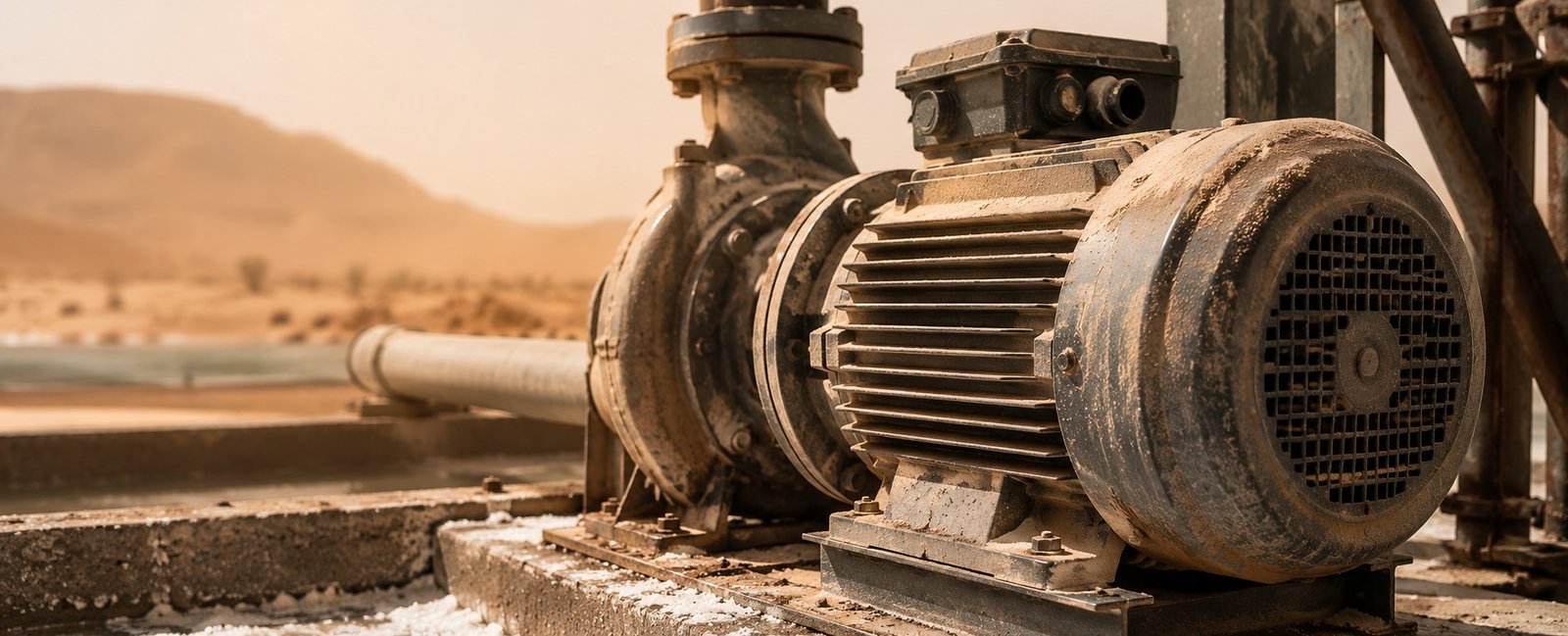
Why it matters: Airborne sand and dust, a routine condition across much of Saudi Arabia and a significant one during seasonal sandstorms, poses a direct risk to motor bearings, windings, and electrical connections if a unit isn’t properly sealed against ingress.
What to look for:
- IP rating (Ingress Protection) specifically rated for dust exposure, commonly IP54 or IP55 for motors operating in dusty outdoor or semi-enclosed environments, confirming both protection against solid particle ingress and limited protection against water exposure.
- Sealed bearings reduce the risk of abrasive dust particles working their way into moving components over time, a slower, cumulative failure mode that isn’t always obvious until a bearing has already sustained damage.
- Filtered ventilation on larger motors, where cooling airflow is drawn from the surrounding environment, prevents dust from being pulled directly into the motor’s internal cooling path along with the air it needs for thermal management.
What to specify: Match IP rating explicitly to actual installation conditions, outdoor, semi-enclosed, or fully enclosed plant room, rather than defaulting to a general industrial rating that may not account for the specific dust exposure of the installation site.
Saline and Brackish Water: Wetted Parts and Seal Material Selection
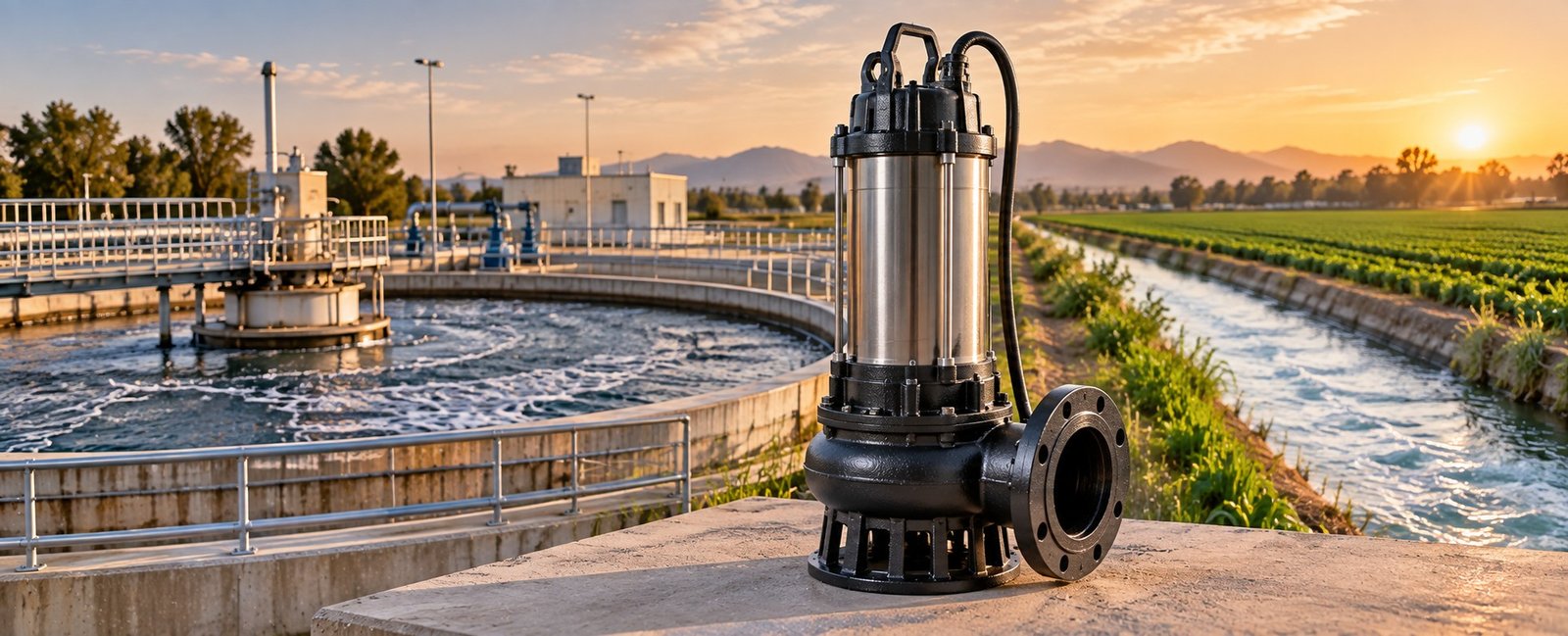
Why it matters: For pumps handling saline or brackish water, common in coastal applications along the Red Sea and Arabian Gulf, including cities like Jeddah, Dammam, Jubail, and Yanbu, standard freshwater-rated wetted components face accelerated corrosion and premature seal failure if material selection doesn’t account for salinity specifically.
What actually needs to change for saline applications:
- Wetted part materials need upgrading beyond standard cast iron or general-purpose bronze toward materials with genuine saline resistance, duplex stainless steel or specifically rated bronze alloys, depending on the application’s salinity level and duty requirements.
- Mechanical seal face materials matter as much as the pump body itself. Silicon carbide seal faces generally offer better resistance to the abrasive and corrosive characteristics of saline water than standard ceramic faces, extending seal life meaningfully in this specific application.
- Corrosion allowance should be factored into material selection from the outset for any saline-handling application, rather than specified at standard freshwater tolerances and expected to perform equivalently.
What to specify: Confirm wetted part material and mechanical seal face material explicitly for any application involving saline, brackish, or otherwise non-standard water chemistry, referencing actual site water conditions rather than assuming standard freshwater-rated components will perform adequately.
Where This Matters Most: Coastal and Desert-Interior Applications Specifically
Why it matters: These three factors don’t apply uniformly everywhere in the Kingdom, and understanding where each one carries the most weight helps prioritize specification effort.
- Coastal cities face the combined challenge of heat, humidity, and saline water exposure simultaneously, making both motor derating and wetted-part material selection genuinely critical considerations together, not just one or the other.
- Desert-interior locations face more extreme heat swings and higher dust exposure, with saline water typically less of a factor unless drawing from specific groundwater sources with high mineral or salt content.
- High-altitude or elevated sites add a further layer, since IEC’s standard reference conditions also assume installation at or below 1,000 metres, meaning altitude-driven derating needs to be considered alongside temperature for any application at meaningful elevation.
What to Specify: A Practical Checklist
- Confirm motor insulation class and derating curve against actual site ambient temperature, not standard reference conditions.
- Factor duty cycle into derating calculations, not just peak ambient temperature alone.
- Specify IP54 or IP55 ingress protection, or higher, for any installation with meaningful dust exposure.
- Confirm sealed bearings and filtered ventilation for larger motors operating in dusty environments.
- Upgrade wetted part materials explicitly for any application involving saline or brackish water.
- Specify mechanical seal face material, silicon carbide over standard ceramic, for saline-handling applications.
- Account for altitude-driven derating separately from temperature-driven derating where elevation is a factor.
A Note on Building Materials vs. Pump Engineering
Why it matters: It’s worth being clear about scope here. This guide covers pump and motor engineering specifically, sizing, sealing, and wetted-part material selection at the equipment level. The related question of how Saudi Arabia’s heat, dust, and coastal conditions affect building hardware and fittings more broadly, valves, fixtures, and construction materials exposed to the same environmental factors, is a distinct topic with its own set of considerations, and deserves its own dedicated treatment rather than being folded into pump-specific engineering guidance here.
Conclusion
Heat, dust, and saline water each affect pump and motor performance through a different mechanism, thermal derating driven by ambient temperature, ingress protection driven by airborne particulate exposure, and material and seal selection driven by water chemistry, and each needs to be specified deliberately rather than assumed to be covered by a standard rating. A pump selected against manufacturer reference conditions alone, without adjusting for the site’s actual ambient temperature, dust exposure, and water quality, is being set up for premature wear or failure well before its expected service life.
Your next steps:
- Confirm actual site ambient temperature, dust exposure, and water salinity before finalizing pump and motor selection.
- Specify insulation class, IP rating, and wetted-part materials explicitly rather than relying on standard reference ratings.
- Explore Kanzotech’s industrial and commercial pump ranges, and see our guide on specifying pumps for Saudi buildings for how to build these considerations into a formal specification.
Specifying pumps for a project with demanding heat, dust, or water quality conditions? Contact Kanzotech Pumps for technical guidance on motor derating and material selection for your site.



 September 12, 2026
 HYZAM KENZ



Comments
No comments yet. Be the first to comment!