Introduction
Quick answer: Water pump prices in Saudi Arabia typically range from around SAR 100 for a small domestic peripheral pump up to SAR 15,000+ for an industrial end-suction unit, excluding 15% VAT. Within that span, most homeowners pay somewhere between SAR 350 and SAR 1,800 for a standard domestic pump or booster pump, while submersible pumps for boreholes and deep wells run roughly SAR 300 to SAR 7,000+ depending on horsepower and depth. Bulk and project pricing for contractors and traders is typically lower per unit than these retail oriented figures, since it scales with order volume, get a project quote for exact numbers.
The rest of this guide breaks that down by pump type, buyer type, and what actually moves the price up or down, so you can place your own requirement before you request a quote.
“A note on how to read the numbers below: these are approximate market ranges compiled from general pricing activity across Saudi Arabia’s plumbing and MEP supply market in 2026, meant to orient you before a purchase, not a fixed Kanzotech price list. Kanzotech’s own bulk and project pricing is quoted per order and is often more competitive than these retail oriented reference points once volume is factored in. Jump to how to get an accurate quote.”
How Much Does a Water Pump Cost in Saudi Arabia? (By Type)
Here’s the general Saudi market range by pump category, in SAR, excluding VAT. Use this to orient your budget , then request a quote for pricing specific to your quantity and specification.
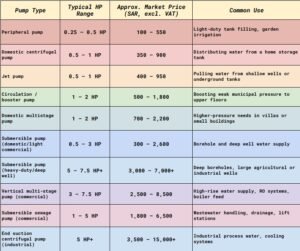
Installation, where relevant, typically adds SAR 150 – 400 for a straightforward domestic setup, and SAR 500 – 1,500 for commercial or multi-floor systems involving pump room work and commissioning. Industrial commissioning is scoped per project.
These ranges hold reasonably steady across Riyadh, Jeddah, and Dammam, though sites farther from these hubs can see modestly higher costs once delivery logistics are factored in.
Booster Pump Price in Saudi Arabia
A standard automatic booster pump for a villa or small commercial building typically runs SAR 500 to SAR 1,800, depending on HP, whether it includes a pressure tank, and whether it’s a fixed-speed or variable-frequency-drive (VFD) unit. VFD-equipped systems, which adjust speed to actual demand and use less electricity over time, sit toward the top of that range or slightly above it.
Worth knowing: a “booster pump” isn’t really a separate pump design, it’s a centrifugal pump doing a specific job, raising pressure in a system that already has some water flowing. A classic example: a villa with fine ground-floor pressure but a weak trickle on the third floor. A single automatic booster pump, correctly sized, usually resolves this without needing anything from the commercial or industrial price tiers.
Submersible Pump Price in Saudi Arabia (Water Motor Pump Price)
This section also answers “water motor pump price,” since in everyday Saudi usage the two terms are frequently used interchangeably.
Submersible pump prices generally range from SAR 300 for a small 0.5 HP unit up to SAR 7,000 or more for a heavy-duty 7.5 HP+ borehole pump, with most residential and light commercial buyers landing somewhere between SAR 650 and SAR 2,600 for a 1.5–3 HP unit.
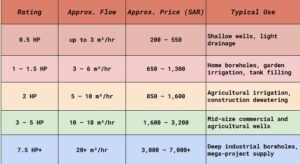
Stainless steel models sit toward the higher end of each band , typically a 20–40% premium over cast iron equivalents, but resist corrosion far better in Saudi Arabia’s often saline or mineral-heavy groundwater. For a permanent borehole or agricultural well, that premium is usually worth it: a well-specified stainless steel unit can run notably longer between overhauls than a cast iron pump in the same water conditions, where mineral buildup and corrosion tend to shorten service life.
Water Motor Price, If You Need the Motor Only
If what you actually need is the motor unit , separate from a complete pump, for a repair, replacement, or custom build, that’s priced differently from a full pump assembly, generally in the SAR 300 to SAR 2,500 range depending on HP and phase (single-phase 220V vs. three-phase 380V). Mismatched motor-pump pairings cause premature failures, so unless you’re specifically sourcing motors for assembly or spares, a matched pump-motor set is usually the safer buy.
Domestic, Commercial, and Industrial Water Pump Prices Compared
Domestic pumps (villas, apartments) sit at the lower end of the market, roughly SAR 250 to SAR 2,600, covering everything from small peripheral pumps to submersible and multistage units for home use.
Explore our Domestic pumps here.
Commercial pumps (buildings, facilities, mid-size infrastructure) run roughly SAR 1,800 to SAR 8,500, priced above domestic equivalents mainly because they’re engineered for continuous or near-continuous duty cycles rather than intermittent home use.
Explore our Commercial pumps here.
Industrial pumps (continuous high-volume operations) generally start around SAR 3,500 and can exceed SAR 15,000 for large end-suction or specialized units, where buyers are typically less price-sensitive on the unit cost and more focused on lifecycle cost, certification, and guaranteed lead times.
What Actually Moves Water Pump Price in Saudi Arabia
- Horsepower and flow rate. The most obvious driver, though not a linear one, a 5 HP commercial pump isn’t simply five times the price of a 1 HP domestic unit, since larger units also carry heavier bearings, windings, and casings.
- Material of construction. Cast iron is the budget option; stainless steel carries a 20–40% premium but resists corrosion far better in Saudi Arabia’s groundwater conditions, which run high in salinity and mineral content in many regions.
- Voltage and phase. Single-phase 220V pumps (villas, small commercial) are priced differently from three phase 380V industrial units, which need heavier motors and compatible switchgear.
- Brand and manufacturing origin. European-engineered brands (Grundfos, Pedrollo, DAB) generally carry a premium over regional or Asian-manufactured equivalents, not automatically “better” for every application, but typically the safer bet for permanent, high-duty installations.
- Certifications. SASO, ISO, and IEC certification is required for most regulated commercial and government-linked projects in the Kingdom, and adds a modest premium over uncertified alternatives.
- Order quantity. The single biggest lever for business buyers. Per-unit cost on a 100-unit order is typically well below the per-unit cost on a single retail purchase.
- Spare parts and after-sales support. A pump priced slightly higher from a supplier who stocks local spare parts is often the better long-term value than a cheaper unit with no regional parts availability, a pump failure mid-project, waiting on parts from overseas, usually costs more than the original savings.
Who Buys Water Pumps in Saudi Arabia And How Their Pricing Differs
“Water pump price” isn’t one question, it plays out differently depending on who’s asking.
Homeowners and villa owners typically buy a single unit , most often a booster pump for weak upper-floor pressure. Retail-style, single-unit pricing applies, with installation as a separate line item.
Contractors and construction project managers buy in batches tied to project timelines, often bundling domestic and commercial pump types with delivery scheduled around construction milestones.
Traders and wholesale/retail distributors buy to resell, making unit economics the priority , the gap between a 20-unit order and a 200-unit order can meaningfully change the per-unit rate.
Industrial and facility buyers procure for ongoing operations, prioritizing specification accuracy over shaving the last percentage point off price, since a mismatched pump in a live facility is a far more expensive problem than a slightly higher unit cost.
Agricultural and irrigation buyers are often seasonal and capacity-driven, needing to move a defined volume of water from a defined depth, submersible pumps dominate this segment, often at meaningful quantities for larger operations.
Real world scenarios
A villa owner in Al Malqa, Riyadh, with fine ground-floor pressure but almost nothing on the third floor: a single mid-range automatic booster pump (roughly SAR 800–1,600 installed) usually resolves it.
A contractor finishing a mixed-use tower in Jeddah needs vertical multi-stage pumps for the main supply, submersible sewage pumps for drainage, and a batch of standard centrifugal units for individual apartments, a project quote spanning three price tiers, coordinated around one delivery timeline.
A hardware trader in Dammam wants consistent stock across a few price points to serve different customer budgets, the conversation is about an ongoing supply relationship and volume pricing, not a single order.
A farm operation in Al-Kharj needs several submersible units running through the irrigation season, depth, flow rate, and total unit count drive the quote far more than brand preference.
Common Pricing Mistakes to Avoid
- Comparing HP without comparing head and flow rate. Two pumps at the same HP can perform very differently, always check flow rate (m³/hr) and total dynamic head, not just horsepower.
- Choosing cast iron for saline or mineral-heavy groundwater to save upfront. This trade off tends to show up within a few years as corrosion-related failure, erasing the initial savings.
- Requesting a quote without specifying quantity. Because pricing scales meaningfully with volume, a request without an estimated quantity range can only ever get a rough estimate back.
- Skipping certification requirements, then discovering the project mandates them. SASO/ISO/IEC certification isn’t optional on most regulated commercial and government linked projects, confirm this before requesting pricing.
Retail Price vs Bulk/Project Price
Retail price is what you’d pay for one unit, off the shelf, with standard terms. It’s straightforward, but it’s not what most B2B buyers actually pay, since most B2B buyers aren’t buying one unit.
Bulk and project pricing accounts for order volume, delivery scheduling, and for contractors and traders, ongoing supply relationships rather than one-off transactions. Working directly with a manufacturer rather than a retail intermediary generally means fewer markups between you and the source.
Frequently Asked Questions
- How much does a water pump cost in Saudi Arabia?
Prices generally range from around SAR 250 for a small domestic peripheral pump to SAR 15,000+ for an industrial system, excluding 15% VAT. Most homeowners land between SAR 350 and SAR 1,800 for a standard domestic or booster pump. The exact figure depends on pump type, HP, material, and order quantity, request a quote for pricing specific to your requirement.
- What is the price difference between a booster pump and a submersible pump?
A booster pump (roughly SAR 500–1,800) increases pressure in a system that already has water flowing, while a submersible pump (roughly SAR 300–7,000+, depending on HP) draws water from a source like a borehole or deep well and generally costs more upfront due to the sealed motor design and installation requirements. Which one you need depends on your water source, not price alone.
- What is the water motor price in Saudi Arabia?
A standalone replacement motor (separate from a full pump assembly) typically runs SAR 300 to SAR 2,500 depending on HP and phase. Most buyers, though, are pricing a complete pump, motor plus impeller, casing, and seals rather than the motor alone.
- Do prices include installation?
Usually not, for bulk and project quotes, installation is scoped separately since it varies enormously by application. As a general reference, domestic installation runs SAR 150 – 400, and commercial or multi-floor installations run SAR 500 – 1,500.
- Is bulk pricing available for contractors and traders?
Yes. Per-unit pricing typically decreases meaningfully with order volume. Contractors, traders, and wholesale buyers should request pricing based on their actual quantity range rather than relying on the retail-oriented figures in this guide.
- Does Kanzotech offer a warranty on pumps?
Yes, warranty terms vary by product category and are confirmed as part of your quote, along with after-sales support.
- Why do prices vary so much between suppliers for what looks like the same pump?
Mainly HP, material, brand origin, certification status, and order quantity, plus, less visibly, spare parts availability and delivery logistics, both of which affect total cost even when they don’t show up on the unit price tag.
Accurate Quote
The ranges above are a starting point for budgeting, not a substitute for a real quote once you know your quantity and specification. Whether you’re a homeowner with one villa, a contractor sourcing for a project, or a trader stocking for resale, submit your requirements, application, capacity, quantity, and timeline and Kanzotech’s team will return detailed, accurate pricing within 24–48 business hours.
“Browse our domestic pump range and submersible pump range, or read our related guides on booster pump vs centrifugal pump, submersible vs centrifugal pump, and single-stage vs multistage pumps.”



 September 12, 2026
 HYZAM KENZ



Comments
No comments yet. Be the first to comment!